
POSITIVE CORNER #31: Learning from each other worldwide

Positive Corner #29 addressed a simple question: How can health systems worldwide learn from each other instead of constantly developing solutions on their own?
The same pattern applies in other areas when someone organizes the exchange and makes experiences usable for others.
Example 1:
The global network C40 connects 96 cities, home to around 920 million people, which, according to C40, account for about 23% of the world economy.

The network helps cities implement climate protection measures more quickly and learn from each other. Its potential impact is significant: what proves successful in one city within the network can serve as a starting point for others.
Mexico City provides a good example. The pilot project there for electrifying its bus service was supported by The Zero Emission Bus Rapid-deployment Accelerator (ZEBRA) Partnership, co-led by the C40 network and the International Council on Clean Transportation (ICCT). The partner network assisted with technical issues, financing, and tendering, and documented the experiences for other cities. Following the positive evaluation of the pilot project, Mexico City further expanded its fleet of electric buses (ref. https://www.c40.org/news/mexico-city-e-buses-zebra/ ). Currently, approximately 20% of Mexico City's nearly 900 buses are electrified, and this number is rising. Already, around 17,000 tons of carbon dioxide emissions are being avoided annually. Furthermore, vehicles that produce significantly less noise or vibration are used (ref. https://politica.expansion.mx/cdmx/2026/08/27/metrobus-cdmx-electrico-2033 ).
Example 2:
The BTCA, based at the United Nations, is a collaborative network of governments, businesses, and international organizations that facilitates access to responsible digital payment methods to contribute to achieving the UN Sustainable Development Goals (SDGs). This can be particularly beneficial where financial inclusion, transparency, or infrastructure are otherwise difficult to guarantee.
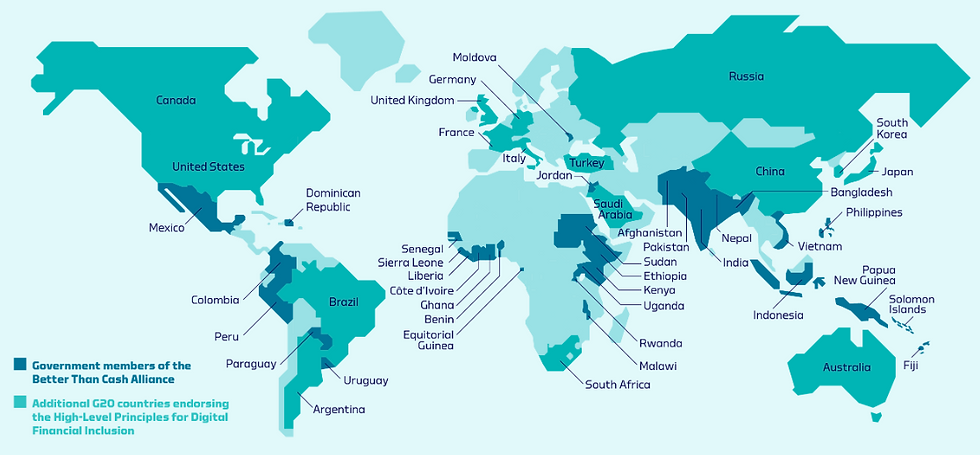
The Philippines provides an example of what mutual learning looks like. When the country sought to further digitize government payments, the BTCA network facilitated a learning visit to Kenya, where advanced experience in this area already existed. Experts from both countries discussed practical hurdles, from coordination between authorities to reliable disbursement (ref. https://www.betterthancash.org/news/learning-from-peers-speeds-the-digitization-process ). As a result of this initiative, the share of government payments (G2X) increased from an estimated 50% (2013) to a measured 98.92% (2025). Notably, the Philippine central bank BSP emphasizes that the measurement method is still based on the procedure developed from 2013 onwards with the support of the BTCA (ref. https://www.bsp.gov.ph/PaymentAndSettlement/2018_The_State_of_Digital_Payments_in_the_Philippines.pdf ; https://www.bsp.gov.ph/PaymentAndSettlement/2025_Report_on_E-payments_Measurement.pdf ).
These examples illustrate an important element of the ω-dimension of leadership: thinking beyond the boundaries of one's own needs and aligning development so that it serves people. Furthermore, not every good idea needs to be reinvented by others or elsewhere. Very often, it can be openly shared, tested, and adapted to a new context. In this way, a local experience becomes a contribution to the progress of many.


Comments